
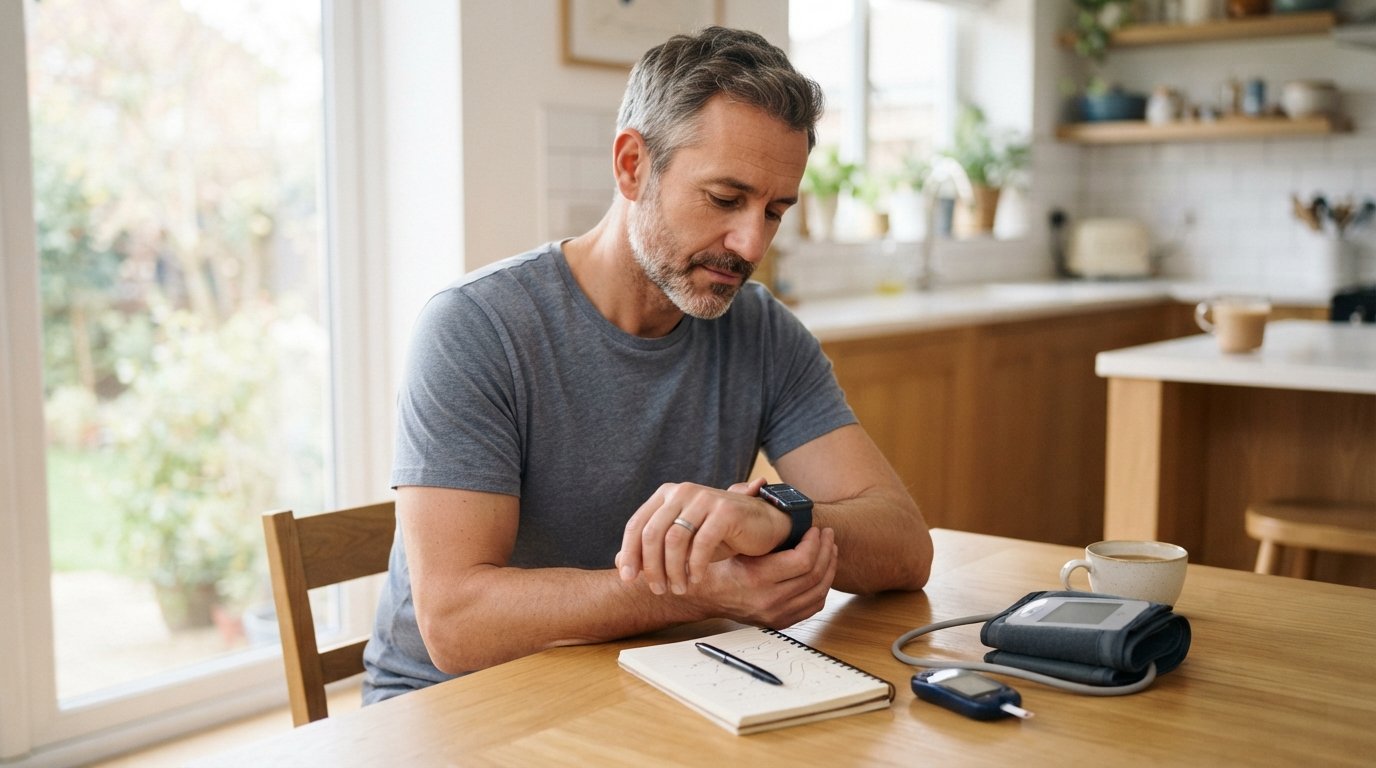
Home Device Health Data: Reading Results Without Diagnosis
Home health devices offer clues, not conclusions. Learn to spot trends, avoid common errors, and know when to bring readings to a clinician.

By Ethan Hayes
Your smart watch buzzes with an alert about an irregular heart rhythm. Your home blood pressure cuff flashes a red number. Your glucose monitor shows a spike after breakfast. In that moment, it is easy to jump to the worst conclusion, or to dismiss the reading entirely. Neither reaction serves you well. The real skill in using at-home health devices is learning to interpret the data as a trend, not a verdict, and to understand what the numbers can and cannot tell you without a formal diagnosis.
The rise of consumer health technology has put powerful data into everyday hands. According to a 2023 survey by the American Heart Association, nearly half of U.S. adults use at least one wearable device, and many more rely on home blood pressure monitors, pulse oximeters, and glucose meters. These tools can offer valuable insights, but they are not diagnostic instruments. They are screening and tracking aids. A single reading, taken in isolation and without clinical context, is rarely meaningful on its own. What matters is the pattern over time, the conditions under which you measured, and whether the data aligns with how you feel. This guide explains how to read results from at-home health devices without falling into the trap of self-diagnosis, and when to bring your findings to a licensed clinician.
Why One Reading Is Rarely the Whole Story
Human physiology is dynamic. Blood pressure, heart rate, blood glucose, and oxygen saturation fluctuate constantly in response to stress, hydration, sleep, caffeine, physical activity, and even the time of day. A single elevated blood pressure reading might reflect the anxiety of rushing to a morning appointment or the lingering effect of a salty dinner. A low oxygen reading might result from cold fingers or poor probe placement. A high glucose reading might simply be the aftermath of a birthday cake. Without repeated measurements and a consistent routine, it is impossible to tell whether a number represents a true deviation from your baseline or a transient blip.
Clinical guidelines recognize this variability. The American Heart Association recommends that home blood pressure monitoring involve two readings taken one minute apart, twice daily, over at least four days, and ideally seven, before drawing conclusions. Similarly, continuous glucose monitors are most useful when paired with context about meals, insulin, and activity. The lesson is clear: a single data point is a snapshot, not a movie. To understand what your device is telling you, you need to look at the film.
Moreover, the thresholds programmed into consumer devices are often generic. They do not account for your age, your medical history, your medications, or your baseline. A heart rate of 55 beats per minute might be perfectly normal for a fit athlete and concerning for someone on a beta-blocker. A blood pressure of 130/85 might be acceptable for one person and a warning sign for another. Without a clinician's input, you cannot know whether a given number is truly out of range for you specifically. This is why self-diagnosis based on a single reading is risky: it applies a population-level threshold to an individual without the necessary context.
Common Sources of Error in At-Home Measurements
Even the most sophisticated home device is only as accurate as the conditions under which it is used. Measurement error is common, and understanding the usual suspects can save you from unnecessary worry. The following are among the most frequent culprits.
- Improper cuff size or placement: A blood pressure cuff that is too small or placed over clothing can read artificially high. A cuff that is too large may read low. Wrist cuffs are particularly sensitive to position relative to the heart.
- Movement and talking during measurement: Talking, fidgeting, or even crossing your legs can raise blood pressure by several points. For pulse oximeters, motion can disrupt the signal entirely.
- Cold hands or poor circulation: Pulse oximeters rely on light passing through tissue. Cold fingers, nail polish, or poor peripheral circulation can cause inaccurate or failed readings.
- Unclean or expired sensors: Glucose test strips expire. Cuffs develop leaks. Wearable sensors can be affected by sweat, lotion, or improper skin contact. Regular calibration and replacement are essential.
- Timing and recent activity: Measuring immediately after exercise, caffeine, smoking, or a stressful event will skew results. Standardized timing (for example, morning and evening at consistent times) reduces this variability.
Beyond device-specific issues, user technique matters enormously. For blood pressure, the arm should be supported at heart level, feet flat on the floor, back supported, and the cuff placed on bare skin. For glucose monitoring, hand washing and proper strip handling are critical. For wearables, consistent wear time and firmware updates ensure data reliability. When you notice an unusual reading, your first step should be to question the measurement itself before questioning your health. Repeat the measurement under ideal conditions. If the reading normalizes, the anomaly was likely technical. If it persists, that is when the data becomes worth noting.
Which Trends Are Worth Mentioning at a Future Appointment
Not every fluctuation deserves a conversation with a clinician, but certain patterns are genuinely useful to bring up. The key is to distinguish between noise and signal. A single outlier is noise. A consistent shift in your baseline is signal. When you prepare for an appointment, focus on trends that have persisted over days or weeks, not isolated readings. The following types of patterns are worth documenting and discussing.
Persistent elevation or depression beyond your usual range. If your home blood pressure readings are consistently above 130/80 over multiple days, or if your resting heart rate has shifted upward by 10 or more beats per minute for no apparent reason, that is a trend worth mentioning. Similarly, if your fasting glucose readings have crept up over several weeks, even if they remain below diagnostic thresholds, it is relevant context for a clinician.
New symptoms paired with data changes. Data becomes far more meaningful when it correlates with how you feel. If your pulse oximeter reads lower than usual and you are experiencing shortness of breath, or if your heart rate spikes coincide with episodes of dizziness, that combination is important. Write down the symptom, the time, and the reading together. This kind of diary helps a clinician see the relationship between subjective experience and objective data.
Medication-related changes. If you start a new medication and notice a shift in your home readings, that is worth flagging. For example, some blood pressure medications can cause heart rate changes, and diabetes medications obviously affect glucose readings. Your clinician needs to know how your body is responding outside the office.
Trends that contradict office measurements. Sometimes home readings tell a different story than the ones taken in a clinic. White coat hypertension (elevated readings in clinical settings but normal at home) and masked hypertension (normal in clinic but elevated at home) are both real phenomena. Bringing your home data to an appointment can help your clinician get a fuller picture.
When you do bring data to an appointment, organize it. A simple log with dates, times, readings, and any relevant context (for example, "after coffee" or "before medication") is far more useful than a vague memory. Many devices and apps allow you to export trends. If you use a wearable, note the specific metric and the timeframe. Do not overwhelm your clinician with every data point; summarize the pattern and highlight the outliers that concern you.
When an Unusual Reading Justifies Contacting a Clinician Promptly
While most variations can wait for a scheduled appointment, certain readings or combinations of symptoms warrant more immediate attention. Knowing when to escalate is an important part of reading your data responsibly. The following situations are red flags that should prompt you to contact a healthcare professional without delay.
Blood pressure readings at or above 180/120 mmHg. The American Heart Association defines this as a hypertensive crisis. If you get a reading this high, wait five minutes and measure again. If it remains elevated, contact your doctor immediately. If you also experience chest pain, shortness of breath, numbness, weakness, vision changes, or difficulty speaking, call 911.
Heart rate abnormalities accompanied by symptoms. A resting heart rate that is consistently above 100 beats per minute (tachycardia) or below 50 beats per minute (bradycardia) in a non-athlete, especially when paired with dizziness, fainting, chest discomfort, or palpitations, deserves prompt evaluation. Many wearables now alert users to irregular rhythms; if you receive such an alert, do not ignore it, but also do not panic. Contact your clinician to discuss the finding and whether further monitoring is needed.
Oxygen saturation below 90 percent. Pulse oximeters can be finicky, so first ensure warm hands and proper placement. If a reading below 90 percent persists and you feel short of breath, confused, or have bluish lips or face, seek emergency care. If you have a chronic lung condition, your clinician may have given you a different threshold to follow.
Glucose readings that are dangerously high or low. For people with diabetes, a blood glucose reading below 70 mg/dL (hypoglycemia) or above 250 mg/dL with symptoms of high blood sugar (excessive thirst, frequent urination, nausea) warrants prompt action. If you are not sure what to do, call your clinician or a telehealth service. If you experience confusion, loss of consciousness, or seizures, call 911.
It is also important to recognize that home devices are not a substitute for professional judgment. If you feel unwell, trust your body over your device. A normal reading does not rule out a problem, and an abnormal reading does not confirm one. The device is a tool to inform, not to diagnose. When in doubt, contact a licensed clinician. Telehealth platforms can be a convenient way to discuss your home data with a provider who can help you interpret it in context. DoctorsHome is an educational resource that explains the topics people look up on telehealth platforms, including how to prepare for a visit and what safety points clinicians typically review. It does not diagnose, prescribe, or sell medication, but it can help you understand what to ask and what to share.
Building a Smarter Approach to Home Health Data
The most effective way to use at-home health devices is to adopt a mindset of curiosity rather than certainty. Treat your readings as clues, not conclusions. Establish a consistent measurement routine so that you can distinguish true trends from noise. Keep a simple log that includes context, not just numbers. And when something seems off, repeat the measurement before reacting. Over time, you will develop a sense of your personal baseline, which is far more informative than any single reading.
Remember that consumer devices are designed for general wellness tracking and screening, not for diagnosis. They can help you notice patterns, prompt conversations with your clinician, and track the effects of lifestyle changes or medications. But they cannot replace a clinical assessment. A diagnosis requires a clinician to integrate your history, symptoms, physical exam, and sometimes laboratory tests. Your home data is one piece of that puzzle, and it is a valuable one, but it is not the whole picture.
Finally, be cautious about over-monitoring. For some people, checking blood pressure or heart rate dozens of times a day can fuel anxiety and lead to unnecessary interventions. If you find yourself obsessively checking, or if the data is making you more worried rather than more informed, talk to your clinician about a reasonable monitoring schedule. The goal is empowerment, not obsession. Used wisely, home health devices can help you become a more engaged partner in your own care, without turning you into your own doctor.